Powering the Depths: How Compressed Air Drives Modern Mining Operations
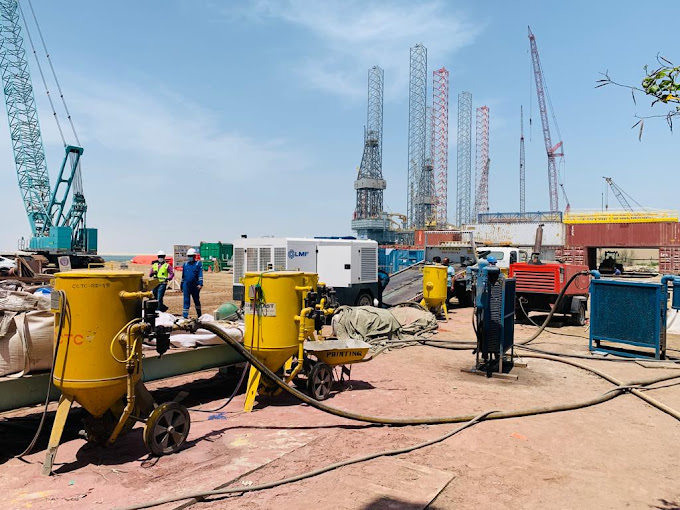
Compressed air is the hidden backbone of modern mining, enabling drilling, ventilation, material handling, and safety systems to operate under punishing conditions. As mines go deeper and the margins for error shrink, operators are rethinking how they source, distribute, and optimize air to meet production and safety goals. The evolution from legacy compressors to intelligent, connected systems has opened a new playbook focused on energy efficiency and reliability. Providers like Fluid-Aire Dynamics are helping mines capture those gains through audits, smart controls, and right-sized equipment that match real-world demand. For teams assessing upgrades or planning new projects, it’s worth exploring how Compressed Air For Mining has changed—and why many digital documentation tools now prompt crews to “Go to Page” references for live schematics, SOPs, and diagnostics embedded in their interfaces.
The Evolution of Compressed Air Technology in Mining Environments
Mining’s reliance on compressed air dates back more than a century, but the technology has advanced dramatically from steam conversions and belt-driven compressors to modern rotary screw units with intelligent controls. Today’s compressors operate with tighter tolerances, cleaner air streams, and significantly lower energy footprints, making them better suited for long duty cycles in both underground and open-pit environments. Oil-free and oil-injected options can be tailored to the task, while heat recovery and high-efficiency motors push lifecycle costs down. Fluid-Aire Dynamics and similar partners now use data logging and simulation to size systems to the mine’s true load profile, which reduces oversizing and the costly pressure bands that come with it. These shifts have turned compressed air from a blunt tool into a finely tuned utility, indispensable to high-output sites.
From Steam Age to Smart Age
The leap forward is powered by IIoT sensors, variable speed drives (VSD), and analytics that stitch together real-time insight across compressors, dryers, and distribution piping. Smart controllers orchestrate multiple machines as a single virtual plant, trimming unload time and holding pressure within a tighter, more efficient band. Dew point monitoring and advanced filtration packages help maintain consistent air quality, protecting valves, percussive tools, and rock drills from contaminant-related wear. As a result, Compressed Air For Mining is no longer just about brute capacity; it’s about stability, quality, and responsiveness to changing loads across shifts and headings. For mines transitioning legacy fleets, a staged modernization plan can yield compounding savings, with improvements in uptime, energy intensity, and maintenance intervals arriving in parallel.
How Air-Powered Drills Improve Efficiency in Underground Operations
Pneumatic drills remain a mainstay for underground projects because they deliver high power density, precise control, and rugged dependability in harsh conditions. Air-powered percussive and rotary-percussive drills offer rapid start-stop cycles and reliable torque without the heat buildup common in purely electric systems. With the right air pressure and flow, crews can sustain optimal penetration rates while minimizing bit wear and reducing stalling. Modern supply systems reduce pressure drops along drifts, helping operators maintain consistent energy at the tool face and reduce cycle time per hole. When paired with well-designed air distribution and moisture control, the result is cleaner holes, fewer misfires, and better overall advance per shift.
Case Study: Hard-Rock Drift Optimization
In a hard-rock drift with variable strata, a VSD-equipped compressor array feeding properly sized air lines stabilized pressure at the face within a narrow tolerance band. That stability translated to consistent hammer frequency and impact energy, improving drilling speed without overdriving bits. Crews reported fewer changeouts, better flushing, and reduced blowback—advantages that accumulate across hundreds of holes. Providers like Fluid-Aire Dynamics often validate these gains with data loggers and flow meters, producing before-and-after profiles that highlight pressure consistency and reduced compressor cycling. For planners evaluating fleet upgrades, a trial setup focused on tool-end performance can prove that the right Compressed Air For Mining configuration pays off in measurable throughput.
Reducing Equipment Downtime Through Advanced Filtration Systems
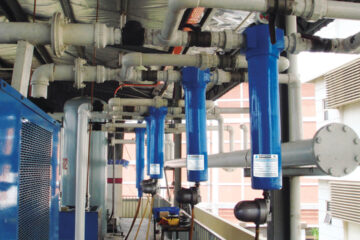
Contaminants are the silent saboteurs of mining air networks, and moisture, oil aerosols, and particulates can accelerate wear across valves, actuators, rock drills, and instrumentation. Modern air trains combine aftercoolers, moisture separators, coalescing filters, and appropriately sized dryers to meet target ISO 8573-1 air classes for each application. When water and oil are controlled, pneumatic seals last longer, control valves respond consistently, and corrosion inside piping slows to a crawl. Advanced filtration also reduces sludge formation and abrasive carryover, lowering the risk of sticking or drifting in precision components. By addressing air quality at the source and at point-of-use, mines can shrink unplanned downtime and cut the total cost of tool ownership.
Designing a Clean Air Train
A robust configuration often starts with a high-efficiency aftercooler and separator, followed by a dual-stage coalescing filter path to strip aerosols and fine particulates before the dryer. For underground operations where dew point matters, desiccant dryers with purge reduction controls can achieve low dew points without excessive energy penalty. After the dryer, a final-dust filter protects downstream equipment and instrument air from carryover, while differential pressure gauges cue timely element changes. Fluid-Aire Dynamics often pairs these elements with smart monitoring so crews can see filter health and dew point in real time, preventing quality drift that slowly erodes performance. In practice, tightening control of air purity yields longer maintenance intervals, steadier tool output, and cleaner pneumatics across the mine.
Safety Standards and Monitoring Tools in 2025 Mining Facilities
Safety in compressed air systems goes far beyond pressure ratings; it includes air quality, noise exposure, hose management, and compliance with MSHA, OSHA, and ASME codes. Underground, pressure lines require secure anchoring, whip-checks, and point-of-use regulators to protect crews at the face. Relief valves, automatic drains, and lockout/tagout procedures form the backbone of safe operation, while enclosure designs and acoustic treatments protect hearing. Mines increasingly integrate compressor safety into centralized control rooms, where alarms for pressure deviations, high dew point, and excessive temperature trigger rapid response. A culture of safety is amplified when visibility is high and trends are easy to interpret.
Sensor Suite for Air Safety
The modern safety stack includes flow, pressure, temperature, vibration, and dew point sensors networked into SCADA or edge gateways, with alarms designed around both absolute thresholds and rate-of-change patterns. For breathable air applications, continuous CO and CO2 monitoring with redundant sensors is standard, and data retention supports regulatory documentation. Smart controllers display operating states and maintenance lockouts, ensuring that technicians confirm isolation before service. Many systems embed digital manuals and SOPs directly in the HMI so crews can quickly “Go to Page” views for E-stop mapping, relief-valve inspection intervals, or hose replacement criteria. With analytics layered on top, safety becomes proactive—intervening before anomalies escalate into incidents.
Balancing Air Pressure and Energy Consumption for Sustainable Output
Compressed air is energy intensive, and in most mines, electricity makes up more than 70% of lifetime compressor costs. Running at higher-than-needed pressures wastes energy, accelerates leaks, and increases tool wear. The path to sustainable output begins with mapping true demand, minimizing artificial demand, and tightening the control band via VSD compressors or master controllers that stage fixed-speed units intelligently. Storage receivers placed near intermittent loads act as buffers, absorbing spikes without forcing a plant-wide pressure lift. By designing for the lowest stable pressure, mines capture immediate savings while improving performance at the end-use.
Practical Tuning Steps for Lean Air
Start by quantifying baseline performance with flow logging and pressure mapping, especially at the tool face and critical valves. Next, right-size compressors and dryers to the observed load profile, leveraging VSD where loads vary and trim machines where loads are steady. Address distribution with larger-diameter headers, ring mains where possible, and minimal dead-ends to reduce pressure drop. Finally, deploy continuous leak detection and heat recovery—waste heat can pre-warm ventilation air or domestic water, cutting overall site energy intensity. Mines that take this holistic approach to Compressed Air For Mining typically see lower kWh per unit of ore moved and a more consistent operating envelope across shifts.
The Role of Predictive Maintenance in Preventing Costly Failures
Reactive maintenance is disruptive and expensive in deep or remote operations, where access alone can consume valuable hours. Predictive maintenance flips the equation by monitoring vibration, motor current signatures, bearing temperatures, dew point, and oil quality to anticipate failures before they trigger downtime. By establishing normal operating envelopes for compressors, dryers, and filters, analytics can flag deviations that hint at wear, misalignment, or contamination. Teams then schedule interventions during planned pauses, reducing the risk of cascading failures that affect drills, shotcrete pumps, and ventilation controls. The payoff is stability: fewer surprises, better parts planning, and longer component life.
Data You Should Track for Reliability
A robust predictive program records vibration spectra on key rotating elements, correlates power draw with delivered flow, and tracks pressure drop across filter elements to quantify loading. Oil analysis helps identify early bearing or gear wear, while thermal imaging can reveal electrical or mechanical hotspots invisible to routine inspection. Dew point and temperature give clues about dryer performance and separator efficiency, which directly influence downstream reliability. With these data streams integrated, mines create dashboards that move from descriptive to prescriptive, alerting teams to likely root causes. Many providers, including Fluid-Aire Dynamics, bundle remote monitoring that centralizes insights and accelerates troubleshooting across multiple sites.
Future Trends: Automation and AI in Mining Air Systems
Automation and AI are reshaping how compressed air is generated, distributed, and consumed, with systems that learn from patterns in geology, shift schedules, and tool behavior. AI-driven controllers dynamically adjust setpoints, compressor sequencing, and dryer loading to match load volatility in real time. Vision and acoustic models are already pinpointing leaks that humans miss, quantifying losses and guiding targeted repairs. Digital twins simulate “what-if” scenarios—adding a drill bank, extending a drift, or switching to a new shift cadence—before capital is committed. The net effect is a move from operating compressed air as a fixed utility to orchestrating it as a responsive, optimized asset.
What to Prepare For in the Next Five Years
Mines should plan for tighter integration between mobile equipment and fixed air infrastructure, including telemetry from drills that informs compressor dispatch. Expect broader adoption of condition-based service contracts where uptime guarantees are backed by continuous monitoring and rapid parts logistics. Edge AI will become standard in controllers, enabling on-site inference for faster decisions even with intermittent connectivity. Teams will increasingly rely on embedded digital documentation and training within HMIs—one screen tap to “Go to Page” for troubleshooting trees, air quality standards, or emergency procedures. As these capabilities mature, leaders who standardize on smart platforms and experienced partners will capture the biggest gains from Compressed Air For Mining, translating technology into safer, more productive operations with less energy waste.




-
How to Store and Transport Seeds Safely Using the Right Bags
Proper seed storage and transportation are essential for protecting crop quality, maintaining ... -
-